Max Jacob

You are currently viewing I was perfectly calm before sinking

 Perigal-Nohor


Someone’s patched up the azure of my sky
My nuptials had two lions standing by
And then Saint Catherine lifted her blade
To prune my honey-colored shrubs in braids—
Two castles on which little towers dwell—
The little castle tower’s scrofules swell.
It’s all that was left in this capitol
With bits of garden scattered here and there
And we could see your coifs of lace as well
Madame Adamunzipper
The color of kipper
Madame Mirabeau, Madame Mirabelle
Nebuchadnezzar’s mother, truth to tell.
Now sailboats returned to this cathedral
One with gold and the other with coal tar
The third one catching fire carried Abelard
While the sea seemed somewhat vegetal
I write in letters that are capital:
I’ll never be but a novice in art
The novices’ necklaces we wear crowns
The one who’s crowned amounts to he who crowns. 

                    translated by Alexander Prikow                           

Virgil


Virgil

 “My comrades, hardly strangers to pain before now, we all have weathered worse. Some god will grant us an end to this as well. You've threaded the rocks resounding with Scylla's howling rabid dogs, and taken the brunt of the Cyclops' boulders, too. Call up your courage again. Dismiss your grief and fear. A joy it will be one day, perhaps, to remember even this. Through so many hard straits, so many twists and turns our course holds firm for Latium. There Fate holds out a homeland, calm, at peace. There the gods decree the kingdom of Troy will rise again. Bear up. Save your strength for better times to come.” 

The Aeneid (Translated by Seamus Healy)

Virgil

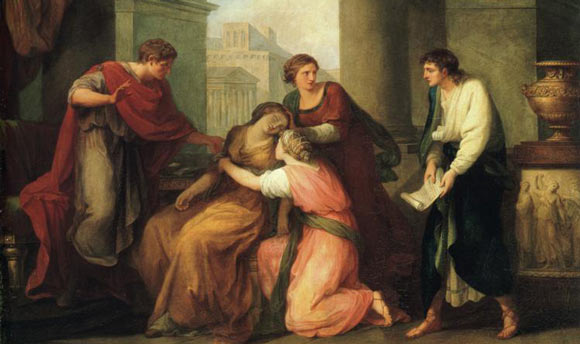
File:M443422 The-Roman-poet-Virgil-declaiming-to-the-Empress-Octavia-his-eleby-on-the-death-of-her-son-Marcellus.jpg

“Then, like ravening wolves in a black mist, when the belly's lawless rage has driven them blindly forth, and their whelps at home await them with thirsty jaws, through swords, through foes we pass to certain death, and hold our way to the city's heart; black night hovers around with sheltering shade.”

*******

“Swift is her walk, more swift her winged haste: A monstrous phantom, horrible and vast. As many plumes as raise her lofty flight, So many piercing eyes inlarge her sight; Millions of opening mouths to Fame belong, And ev'ry mouth is furnish'd with a tongue, And round with list'ning ears the flying plague is hung. She fills the peaceful universe with cries; No slumbers ever close her wakeful eyes; By day, from lofty tow'rs her head she shews, And spreads thro' trembling crowds disastrous news; With court informers haunts, and royal spies; Things done relates, not done she feigns, and mingles truth with lies. Talk is her business, and her chief delight To tell of prodigies and cause affright.” 

The Aeneid  (translation by Robert Fitzgerald)

Sandro Penna


unnamed.jpg

n his poetry Penna clearly says who he is and how he feels. That is a rare enough quality these days. He moves away from the trappings of identity toward an honest expression of love. In Penna’s work the beautiful is not conscious of itself and is therefore erotic: “Is not the beauty of those who are unaware of their beauty / more beautiful than those who are aware?” He is critical of those who hide their desires behind a thin façade of modesty:

Here they are, these lords of life.

They are very modest, indeed.

Even with their senses fully aroused,

they manage to offend no one.

Penna never hid his sexuality in interviews. He once told a reporter (who probably had to pay dearly for the interview), “I am not a homosexual. I am a pederasta.…Homosexuality is a privilege.” Penna’s homosexuality is complicated in one sense by a moral dilemma:

The problem of sex

consumes my entire life.

I wonder at each moment

whether I am doing the right thing

or the wrong.

But there is another sense in which Penna accepts the impossibility of a moral resolution to his “problem” and instead turns this negative to a positive value:

There are always boys in my poems.

But I do not know how to speak of anything else.

Everything else is just a tedious noise.

I am unable to sing of Good Deeds.

Since his poems chiefly concern homosexual love, they face being relegated to a gay-only ghetto of readers or to another ghetto that even homosexuals avoid: pederastia. This is a problematic issue in the United States where scandal surrounding sexual orientation is still prevalent. But more importantly, there are no glamorous pronouncements or concern with gender politics in Penna’s poetry. You also won’t find a vision of historical process or a mass of physical details. What you will find is an attachment to everyday reality. Penna’s poetry is candid, uncluttered, minimalist, and of profound lyrical intensity and as Pasolini, a great supporter of Penna’s work, wrote in the 1970 preface to Penna’s collected poems, he is, “perhaps t

Catullus

CATULLUS 112

Multus home es, Naso, neque tecum multus homost qui
descendit: Naso, multus es et pathicus.

Literal translation by Celia Zukofsky:
Much a man you are, Naso, and that you much a man it is who 
comes down: Naso, much you are and pathetic/lascivious. 

Cornish edition in the Loeb Classical Library (used by the Zukofskys):
You are many men's man, Naso, but not many men go down town with you: Naso, you are many men's man and minion.

Peter Green (2005):
You're such a macho guy, Naso, yet few other macho guys seek your
company. How so? Naso, you're macho—and a queen. 

The Zukofskys's homophonic version (1969)
Mool ’tis homos,’ Naso, ’n’ queer take ’im mool ’tis ho most he
     descended: Naso, mool ’tis – is it pathic, cuss.


Catullus


Catullus

Louis Zukofsky and his wife, Celia, experimented with homophonic translations (something pioneered by Pound, I believe) of the Roman poet, Catullus (c.85-54 BC). That is, they tried to get both the meaning and the actual SOUNDS of the Latin across, in English. The results range from the wacky to the impressive. It doesn’t matter if you don’t know Latin—just try sounding out these few lines from poem 8 phonetically:

Miser Catulle, desinas ineptire,
et quod vides perisse perditum ducas.
fulsere quondam candidi tibi soles...
(for whole poem in Latin, click here --you can also click through to English translation.)
Then read the first lines of Louis Zukofsky's translation aloud:

Miss her, Catullus? don't be so inept to rail
at what you see perish when perished is the case.
Full, sure once, candid the sunny days glowed, solace,
when you went about it as your girl would have it,
you loved her as no one else shall ever be loved.
Billowed in tumultuous joys and affianced,
why you would but will it and your girl would have it.
Full, sure, very candid the sun's rays glowed solace.
Now she won't love you; you, too, don't be weak, tense, null,
squirming after she runs off to miss her for life.
Said as if you meant it: obstinate, obdurate.
Vale! puling girl. I'm Catullus, obdurate,
I don't require it and don't beg uninvited:
won't you be doleful when no one, no one! begs you,
scalded, every night. Why do you want to live now?
Now who will be with you? Who'll see that you're lovely?
Whom will you love now and who will say that you're his?
Whom will you kiss? Whose morsel of lips will you bite?
But you, Catullus, your destiny's obdurate.

A. E. STALLINGS
---

I think even Catullus would have got a kick out of "Vale! puling girl."
It's a fun experiment that can yield surprising results--maybe it even helps if you don't know the original language.

Sandro Penna

250420101238Penna anni trenta


I have found my little angel

amid a shady audience.
Smoking a small cigar
and with shining eyes..


Fernando Pessoa/Alvaro de Campos

  I Got Off the Train I got off the train And said goodbye to the man I'd met. We'd been together for eighteen hours And had a pleas...