Cesare Pavese


 “And then we cowards”

TRANSLATED BY GEOFFREY BROCK
And then we cowards
who loved the whispering
evening, the houses,
the paths by the river,
the dirty red lights
of those places, the sweet
soundless sorrow—
we reached our hands out
toward the living chain
in silence, but our heart
startled us with blood,
and no more sweetness then,
no more losing ourselves
on the path by the river—
no longer slaves, we knew
we were alone and alive.

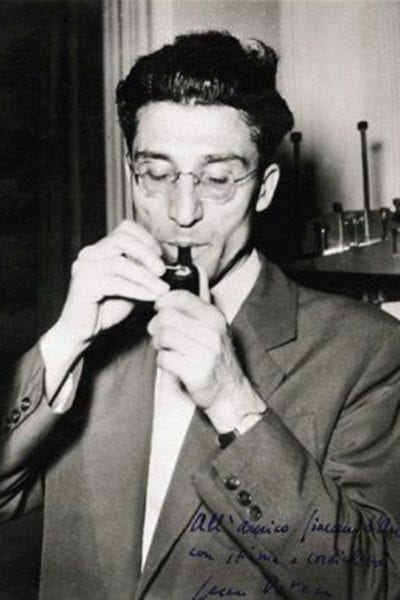
Cesare Pavese


Cesare_Pavese_Italian_Novelist_Poet_1930

Passion for Solitude

TRANSLATED BY GEOFFREY BROCK
I’m eating a little supper by the bright window.
The room’s already dark, the sky’s starting to turn.
Outside my door, the quiet roads lead,
after a short walk, to open fields.
I’m eating, watching the sky—who knows
how many women are eating now. My body is calm:
labor dulls all the senses, and dulls women too.

Outside, after supper, the stars will come out to touch
the wide plain of the earth. The stars are alive,
but not worth these cherries, which I’m eating alone.
I look at the sky, know that lights already are shining
among rust-red roofs, noises of people beneath them.
A gulp of my drink, and my body can taste the life
of plants and of rivers. It feels detached from things.
A small dose of silence suffices, and everything’s still,
in its true place, just like my body is still.

All things become islands before my senses,
which accept them as a matter of course: a murmur of silence.
All things in this darkness—I can know all of them,
just as I know that blood flows in my veins.
The plain is a great flowing of water through plants,
a supper of all things. Each plant, and each stone,
lives motionlessly. I hear my food feeding my veins
with each living thing that this plain provides.

The night doesn’t matter. The square patch of sky
whispers all the loud noises to me, and a small star
struggles in emptiness, far from all foods,
from all houses, alien. It isn’t enough for itself,
it needs too many companions. Here in the dark, alone,
my body is calm, it feels it’s in charge.

Arthur Rimbaud


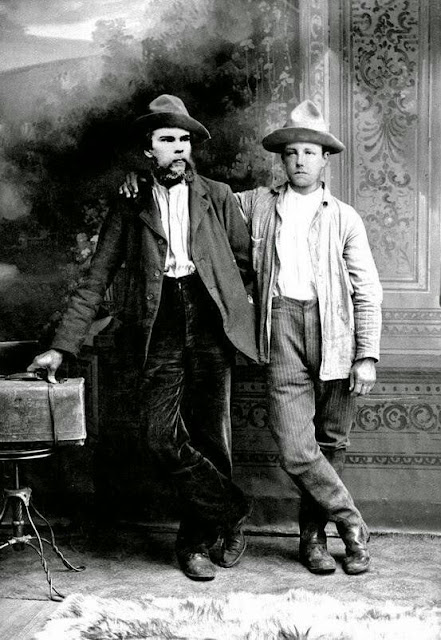
Paul Verlaine and Arthur Rimbaud


The Seekers of Lice

When the child’s forehead, cursed with furies, red blisters, pines for a forgetful swarm of pathetic dreams,
there steps to his bed two rangy, highborn sisters
—silver nails extended from refined, slender limbs.

They fix the child in a chair before a window
showing on the blue air that bathes fecund meadows;
they drive, through hair matted with sweat and morning dew, their charming, delicate fingers, cruel as new snow.

He hears their sibilance, their halting song, their breath thick with honey odor, vegetable, roseate,
broken here and there by their spittle’s sucked hisses, their plays for kisses thwarted, stillborn, celibate.

He hears black eyelashes flutter in the perfumed silence; their electric fingers craft paradise,
a half-drunk indolence, while through the humid room crackle the royal nails crushing the little lice.

But then: the wine of Sloth rises in him; the sigh of a harmonica bruises the azure sky.
The tympanic flows of their fingers catalyze, surging, dying, surging in him—the need to cry.

1870-1872

Arthur Rimbaud


Voyelles

A noir, E blanc, I rouge, U vert, O bleu: voyelles, 

Je dirai quelque jour vos naissances latentes: 
A, noir corset velu des mouches éclatantes 
Qui bombinent autour des puanteurs cruelles, 

Golfes d'ombre; E, candeurs des vapeurs et des tentes, 
Lances des glaciers fiers, rois blancs, frissons d'ombelles; 
I, pourpres, sang craché, rire des lèvres belles 
Dans la colère ou les ivresses pénitentes; 

U, cycles, vibrements divins des mers virides, 
Paix des pâtis semés d'animaux, paix des rides 
Que l'alchimie imprime aux grands fronts studieux; 

O, suprême Clairon plein des strideurs étranges, 
Silences traversés des [Mondes et des Anges]: 
—O l'Oméga, rayon violet de [Ses] Yeux!

Arthur Rimbaud


    David Wojnarowicz. 

    Arthur Rimbaud in New York (1979)


To a Reason

TRANSLATED FROM THE FRENCH BY JOHN ASHBERY
A tap of your finger on the drum releases all sounds and initiates the new harmony.
      A step of yours is the conscription of the new men and their marching orders.
     You look away: the new love!
     You look back,—the new love!
     “Change our fates, shoot down the plagues, beginning with time,” the children sing to you. “Build wherever you can the substance of our fortunes and our wishes,” they beg you.
     Arriving from always, you’ll go away everywhere.

Arthur Rimbaud

Jef Rosman's oil painting of Arthur Rimbaud (1854-1891) in his Bed, Wounded by Verlaine in 1873

 Vagabonds

TRANSLATED BY REYNOLDS PRICE
Pitiful brother—the dreadful nights I owed him! “I’ve got no real involvement in the business. I toyed with his weakness, so—it was my fault—we wound up back in exile and enslavement.”

He saw me as a loser, a weird child; he added his own prods.

I answered my satanic doctor, jeering, and made it out the window. All down a landscape crossed by unheard-of music, I spun my dreams of a nighttime wealth to come.

After that more or less healthy pastime, I’d stretch out on a pallet. And almost every night, soon as I slept, my poor brother would rise—dry mouth and bulging eyes (the way he’d dreamt himself!)—and haul me into the room, howling his stupid dream.

Truly convinced, I’d vowed to take him back to his primal state—child of the sun—and so we wandered, fed on wine from the caves and gypsy bread, me bound to find the place itself and the code.

J. S. Tennant after Rimbaud

File:Rimbaud Carjat 1871 Claudel.jpg


 J S TENNANT

The Sleeper in the Valley

After Rimbaud

You can hear the engine idling lazily
Through the knotted roadside hawthorn hedge
By the turn-off. The chassis fits snugly
Between fence and verge: its sun-bright wharfage.

A young man, head slung back, open mouthed,
Kips among the dog rose and cow parsley.
He lounges in the driver’s seat, shrouded
By spring from the sun on the barley.

His alloys couched in arum lilies, he sleeps;
A convalescent’s smile etched across his face.
Coddle him, gentle earth, his sleep is deep––

To you he will never repay his debt.
He sleeps in the shade, one hand on the wheel
And on the cracked windscreen his scalp, a red rosette.

Fernando Pessoa/Alvaro de Campos

  I Got Off the Train I got off the train And said goodbye to the man I'd met. We'd been together for eighteen hours And had a pleas...