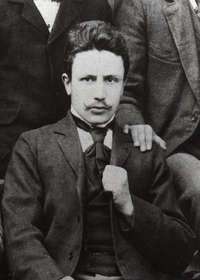
Arthur Rimbaud


Voyelles

A noir, E blanc, I rouge, U vert, O bleu: voyelles, 

Je dirai quelque jour vos naissances latentes: 
A, noir corset velu des mouches éclatantes 
Qui bombinent autour des puanteurs cruelles, 

Golfes d'ombre; E, candeurs des vapeurs et des tentes, 
Lances des glaciers fiers, rois blancs, frissons d'ombelles; 
I, pourpres, sang craché, rire des lèvres belles 
Dans la colère ou les ivresses pénitentes; 

U, cycles, vibrements divins des mers virides, 
Paix des pâtis semés d'animaux, paix des rides 
Que l'alchimie imprime aux grands fronts studieux; 

O, suprême Clairon plein des strideurs étranges, 
Silences traversés des [Mondes et des Anges]: 
O l'Oméga, rayon violet de [Ses] Yeux!

Arthur Rimbaud


    David Wojnarowicz

    Arthur Rimbaud in New York (1979)


To a Reason

TRANSLATED FROM THE FRENCH BY JOHN ASHBERY
A tap of your finger on the drum releases all sounds and initiates the new harmony.
      A step of yours is the conscription of the new men and their marching orders.
     You look away: the new love!
     You look back,—the new love!
     “Change our fates, shoot down the plagues, beginning with time,” the children sing to you. “Build wherever you can the substance of our fortunes and our wishes,” they beg you.
     Arriving from always, you’ll go away everywhere.

Arthur Rimbaud

Jef Rosman's oil painting of Arthur Rimbaud (1854-1891) in his Bed, Wounded by Verlaine in 1873

 Vagabonds

TRANSLATED BY REYNOLDS PRICE
Pitiful brother—the dreadful nights I owed him! Ive got no real involvement in the business. I toyed with his weakness, so—it was my fault—we wound up back in exile and enslavement.

He saw me as a loser, a weird child; he added his own prods.

I answered my satanic doctor, jeering, and made it out the window. All down a landscape crossed by unheard-of music, I spun my dreams of a nighttime wealth to come.

After that more or less healthy pastime, Id stretch out on a pallet. And almost every night, soon as I slept, my poor brother would rise—dry mouth and bulging eyes (the way hed dreamt himself!)—and haul me into the room, howling his stupid dream.

Truly convinced, Id vowed to take him back to his primal state—child of the sun—and so we wandered, fed on wine from the caves and gypsy bread, me bound to find the place itself and the code.

J. S. Tennant after Rimbaud

File:Rimbaud Carjat 1871 Claudel.jpg


 J S TENNANT

The Sleeper in the Valley

After Rimbaud

You can hear the engine idling lazily
Through the knotted roadside hawthorn hedge
By the turn-off. The chassis fits snugly
Between fence and verge: its sun-bright wharfage.

A young man, head slung back, open mouthed,
Kips among the dog rose and cow parsley.
He lounges in the driver’s seat, shrouded
By spring from the sun on the barley.

His alloys couched in arum lilies, he sleeps;
A convalescent’s smile etched across his face.
Coddle him, gentle earth, his sleep is deep––

To you he will never repay his debt.
He sleeps in the shade, one hand on the wheel
And on the cracked windscreen his scalp, a red rosette.

Arthur Rimbaud


fd2d4e1ed4fb58f44fb719ee6b1e31b6.jpg

Le Dormeur du Val

C’est un trou de verdure où chante une rivière,
Accrochant follement aux herbes des haillons
D’argent ; où le soleil, de la montagne fière,
Luit : c’est un petit val qui mousse de rayons.

Un soldat jeune, bouche ouverte, tête nue,
Et la nuque baignant dans le frais cresson bleu,
Dort ; il est étendu dans l’herbe, sous la nue,
Pâle dans son lit vert où la lumière pleut.

Les pieds dans les glaïeuls, il dort. Souriant comme
Sourirait un enfant malade, il fait un somme :
Nature, berce-le chaudement : il a froid.

Les parfums ne font pas frissonner sa narine ;
Il dort dans le soleil, la main sur sa poitrine,
Tranquille. Il a deux trous rouges au côté droit.


The Sleeper in the Valley

It’s a green hole where a river sings
As it madly hangs onto the grass its rags
Of silver; where the sun, from the proud mountain,
Shines down: it’s a little valley bubbling with light.

A young soldier, open mouth, bare head,
And neck bathing in the sweet blue watercress,
Sleeps; he is stretched out among the grass, beneath the skies,
Pale in his green bed where the light rains down.

Feet in the gladiolas, he sleeps. Smiling like
An ill child would smile, he takes a nap:
Nature, cradle him in warmth: he is cold.

Fragrances don’t make his nostrils quiver:
He sleeps in the sun, one hand on his chest,
Motionless: he has two red holes in his right side.


                                                                Translated by Wallace Fowlie                


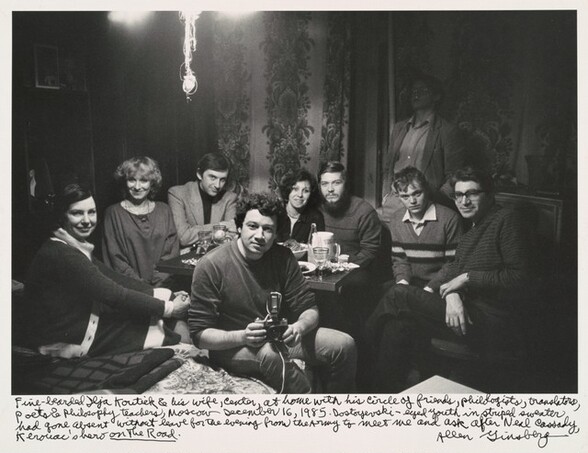
Ilya Kutik


Fine-bearded Ilya Kutik & his wife, center, at home with his circle of friends, philologists, translators, poets & philosophy teachers, Moscow December 16, 1985. Dostoevsky-eyed youth in striped sweater had gone absent without leave for the evening from the Army to meet me and ask after Neal Cassady, Kerouac's hero On the Road., 1985

David and Orpheus

On his simple harp he sings praise to Him,
Who created us. His voice trembles from uncertainty
in himself, but not in Him, the Only, the Formidable – no escape.

Over his Apollonian lyre, having left behind the gloom
of Hades, he runs his fingers, not knowing amongst this scenery
which god to sing his song for in the present forest landscape:

of that oak? of that there pine? of that river? which to?
Again – the problems of Paris? He’ll play for any o’ youse
easily, even in the rain. But for which one ought he?

David, now, sits under a tree. From soul rupture
after the Anointing – life is like the branches
his ancestors have hung their harps on ever since captivity.

~

Harp, you are like the cheekbone
of cubism, you are like an icon-
precipice falling down,
and alongside – a saint and his mount.

Lyre, your sides
are incurved so like lips,
that Pan says to Apollo: “I
knew not of such a tulip.”


Dino Compano

The night

Their shadows slithered along the ruined reddish walls: he followed, robotically. He said to the woman one word that fell in the silence of the afternoon: an old man turned to look at him with a gaze absurd shining and empty. And the woman smiled always a smile feeble in the afternoon aridity, stupid and alone in the catastrophic light


Fernando Pessoa/Alvaro de Campos

  I Got Off the Train I got off the train And said goodbye to the man I'd met. We'd been together for eighteen hours And had a pleas...