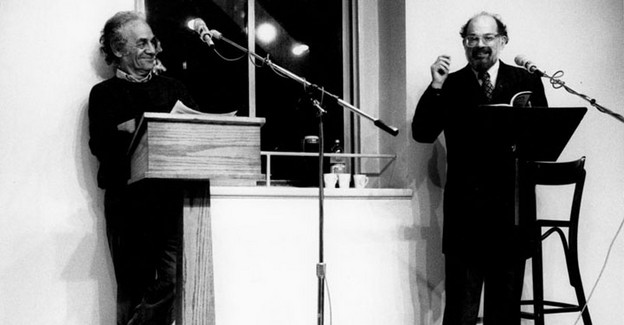
Nicanor Parra


Nicanor Parra and Allen Ginsberg – Photo Credit: Vivian Selbo.


fromAlthrough I haven't come preparraed

por Dave Oliphant

For a nation of only 13 million inhabitants, Chile has the distinction of being the birthplace of at least five world-renowned poets, two of those, Gabriela Mistral and Pablo Neruda, winners of the Nobel Prize for literature. A third poet who has been touted as deserving of the Noble Prize is the 84-year-old self-proclaimed antipoet, Nicanor Parra. The concept of antipoetry as prescribed by Parra -"You can do anything in poetry"; "in sincerity lies the danger" and "truth is a collective error" -owes something of its iconoclastic outrageousness to an earlier Chilean poet, Vicente Huidobro, who declared that "the poet is a little God" and "an adjective, when it doesn't give life, takes it away.". Following both Huidobro and Parra, a fifth Chilean poet, Enrique Lihn, carried on the antipoetry tradition by attacking both his medium and himself as the messenger, asserting that poetry is "a big pile of muck stirred by chance" and the poet is "a rotten little rhetorician." Despite what may seem an overly negative and therefore limited approach to the making of a poem, Chilean poets have produced in the antipoetic mode some of the most provocative and original writing of the last half of the twentieth century.

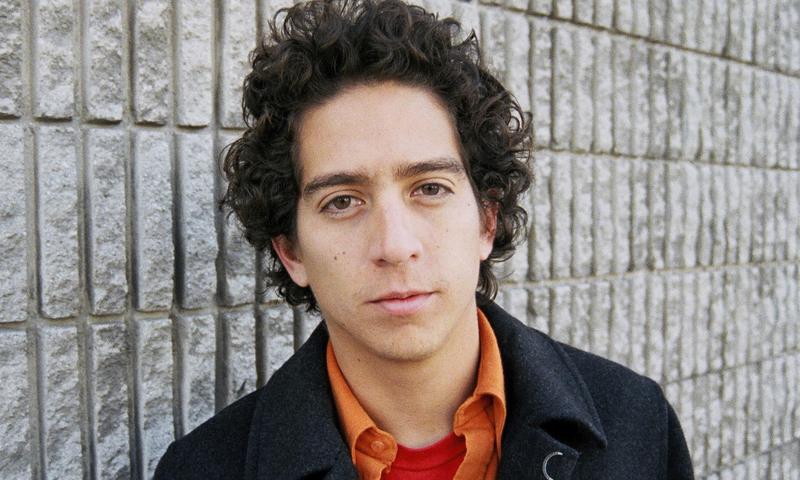
Nicanor Parra


"Help!'

 I don’t know how I got here:

I was running along happy as you please
My hat in my right hand
Chasing a phosphorescent butterfly 
Who drove me crazy with joy

And suddenly zap! I tripped
I don’t know what’s happened to the garden
The whole thing went to pieces
My nose and my mouth are bleeding.

Honestly I don’t know what’s going on
Either give me some help
Or a bullet in the head.

Daniel Alarcon


except from At Night We Walk in Circles

DURING THE WAR—which Nelson’s father called the anxious years—a few radical students at the Conservatory founded a theater company. They read the French surrealists, and improvised adaptations of Quechua myths; they smoked cheap tobacco, and sang protest songs with vulgar lyrics. They laughed in public as if it were a political act, baring their teeth and frightening children. Their ranks were drawn, broadly speaking, from the following overlapping circles of youth: the longhairs, the working class, the sex-crazed, the poseurs, the provincials, the alcoholics, the emotionally needy, the rabble-rousers, the opportunists, the punks, the hangers-on, and the obsessed. Nelson was just a boy then: moody, thoughtful, growing up in a suburb of the capital with his head bent over a book. He was secretly in love with a slight, brown-haired girl from school, with whom he’d exchanged actual words on only a handful of occasions. At night, Nelson imagined the dialogues they would have one day, he and this waifish, perfectly ordinary girl whom he loved. Sometimes he would act these out for his brother, Francisco. Neither had ever been to the theater.


Daniel Alarcon


excerpt from Lost City Radio


 "Yes," Victor said. 

"Do you know him?" 

Norma didn't. 

"He says he came from the jungle," Len continued. "We thought you'd want to meet him. For the show." 

"Great," she said. "Thank you." 

Elmer stood and walked to the window. He was a silhouette against the hazy brightness. Norma knew that panorama: the city below, stretching to the horizon and still farther. With your forehead to the glass, you could see down to the street, to that broad avenue choked with traffic and people, with buses and moto-taxis and vegetable carts. Or life on the city's rooftops: clothes hanging on a line next to rusting chicken coops, old men playing cards on a milk crate, dogs barking angrily, teeth bared at the heavy sea air. She'd even seen a man once, sitting on his yellow hard hat, sobbing. 

If Elmer saw anything now, he didn't seem interested. He turned back to them. "Not just from the jungle, Norma. From 1797." 

Norma sat up straight. "What are you telling me, Elmer?" 

It was one of the rumors they knew to be true: mass graves, anonymous villagers, murdered and tossed into ditches. They'd never reported it, of course. No one had. They hadn't spoken of this in years. She felt something heavy in her chest. 

"It's probably nothing," Elmer said. "Let's show her the note." 

From his pocket, Victor produced a piece of paper, presumably the same one he had shown the receptionist. He passed it to Elmer, who put on his reading glasses and cleared his throat. He read aloud: 

Dear Miss Norma: 

This child is named Victor. He is from Village 1797 in the eastern jungle. We, the residents of 1797, have pooled our monies together and sent him to the city. We want a better life for Victor. There is no future for him here. Please help us. Attached find our list of lost people. Perhaps one of these individuals will be able to care for the boy. We listen to Lost City Radio every week. We love your show. 

Your biggest fans,
Village 1797 


Pablo Neruda


Tonight I can write the saddest lines.

Write, for example, 'The night is starry and the stars are blue and shiver in the distance.'

The night wind revolves in the sky and sings.

Tonight I can write the saddest lines.
I loved her, and sometimes she loved me too.

Through nights like this one I held her in my arms.
I kissed her again and again under the endless sky.

She loved me, sometimes I loved her too.
How could one not have loved her great still eyes.

Tonight I can write the saddest lines.
To think that I do not have her. To feel that I have lost her.

To hear the immense night, still more immense without her.
And the verse falls to the soul like dew to the pasture.

What does it matter that my love could not keep her.
The night is starry and she is not with me.

This is all. In the distance someone is singing. In the distance.
My soul is not satisfied that it has lost her.

My sight tries to find her as though to bring her closer.
My heart looks for her, and she is not with me.

The same night whitening the same trees.
We, of that time, are no longer the same.

I no longer love her, that's certain, but how I loved her.

My voice tried to find the wind to touch her hearing.

Another's. She will be another's. As she was before my kisses.
Her voice, her bright body. Her infinite eyes.

I no longer love her, that's certain, but maybe I love her.
Love is so short, forgetting is so long.

Because through nights like this one I held her in my arms
my soul is not satisfied that it has lost her.

Though this be the last pain that she makes me suffer
and these the last verses that I write for her.

                                                    
Translation by W. S. Merwin

Pablo Neruda

 File:Neruda 100 love sonnets.jpg

Love Sonnet XII 


Full woman, fleshly apple, hot moon,
thick smell of seaweed, crushed mud and light,
what obscure brilliance opens between your columns?
What ancient night does a man touch with his senses?

Loving is a journey with water and with stars,
with smothered air and abrupt storms of flour:
loving is a clash of lightning-bolts
and two bodies defeated by a single drop of honey.

Kiss by kiss I move across your small infinity,
your borders, your rivers, your tiny villages,
and the genital fire transformed into delight

runs through the narrow pathways of the blood
until it plunges down, like a dark carnation,
until it is and is no more than a flash in the night.

	      (translated by Stephen Mitchell)

Pablo Neruda


Morning (Love Sonnet XXVII)

Naked you are simple as one of your hands;
Smooth, earthy, small, transparent, round.
You've moon-lines, apple pathways
Naked you are slender as a naked grain of wheat.

Naked you are blue as a night in Cuba;
You've vines and stars in your hair.
Naked you are spacious and yellow
As summer in a golden church.

Naked you are tiny as one of your nails;
Curved, subtle, rosy, till the day is born
And you withdraw to the underground world.

As if down a long tunnel of clothing and of chores;
Your clear light dims, gets dressed, drops its leaves,
And becomes a naked hand again.

Fernando Pessoa/Alvaro de Campos

  I Got Off the Train I got off the train And said goodbye to the man I'd met. We'd been together for eighteen hours And had a pleas...