Arthur Rimbaud

 Au Cabaret Vert

         cinq heures du soir

Depuis huit jours, j’avais déchiré mes bottines
Aux cailloux des chemins. J’entrais à Charleroi.
– Au Cabaret-Vert : je demandai des tartines
De beurre et du jambon qui fût à moitié froid.

Bienheureux, j’allongeai les jambes sous la table
Verte : je contemplai les sujets très naïfs
De la tapisserie. – Et ce fut adorable,
Quand la fille aux tétons énormes, aux yeux vifs,

– Celle-là, ce n’est pas un baiser qui l’épeure ! –
Rieuse, m’apporta des tartines de beurre,
Du jambon tiède, dans un plat colorié,

Du jambon rose et blanc parfumé d’une gousse
D’ail, – et m’emplit la chope immense, avec sa mousse
Que dorait un rayon de soleil arriéré.

 [Robert Lowell translation]

For eight days I had been knocking my boots
on the road stones. I was entering Charleroi.
At the Green Cabaret, I called for ham,
half cold, and a large helping of tartines.

Happy, I kicked my shoes off, cooled my feet
under the table, green like the room, and laughed
at the naive Belgian pictures on the wall.
But it was terrific when the house-girl

with her earth-mother tits and come-on eyes—
no Snow Queen having cat-fits at a kiss—
brought me tarts and ham on a colored plate 

She stuck a clove of garlic in the ham,
red frothed by white, and slopped beer in my stein,
foam gilded by a ray of the late sun.

[Ezra Pound translation]

Wearing out my shoes, 8th day
On the bad roads, I got into Charleroi.
Bread, butter, at the Green Cabaret
And the ham half cold.

Got my legs stretched out
And was looking at the simple tapestries,
Very nice when the gal with the big bubs
And lively eyes,

Not one to be scared of a kiss and more,
Brought the butter and bread with a grin
And the luke-warm ham on a colored plate…

Pink ham, white fat and a sprig
Of garlic, and a great chope of foamy beer

Gilt by the sun in that atmosphere.
Eugenio Montale

 “The Blackcap Wasn’t Killed”

The blackcap wasn’t killed
by a hunter,
so far as I know.
Perhaps she died mid-morning. And I never
got the news. Regarding me, I suppose
she had lost all recollection. If some
ghostly presence flutters around here now,
I can’t capture it to ask: “Who are you?”
It may be that ghosts have no more substance
than a faint breath of wind. Perhaps I, too,
am just one of these puffs and don’t know it,
a breeze so light the cardboard stage-set
that surrounds me manages to stand upright.
To destroy it will take different gusts entirely.
Where will they take refuge then, these stray
bits of gossamer?
There exists no science,
philosophy, theology that concerns itself with them.

The Allegory

The meaning of the plot is unclear
even to those whom it concerns.

We’re just supporting actors, prompters in the pit,
but the story line is in the hands of others.
Clearly we’re dealing with an allegory
lasting an infinitude of centuries, assuming
that time exists, or rather that it is not part
of some great machination, divine or otherwise.
There are those who posit thingamajigs causing
the whole of everything to collapse into itself.
But you don’t believe this. The rapture of lunatics
is somebody else’s business.

Anne-Marie Albiach


The Hermitage Road (detail)

Parallel life of corporeal horizons already lived—the ties loosen along a trajectory, leaving to silence a dynamic of power or of destruction.


The contour of an outline constrains the masked face and the limbs, encloses wrists and wristlets, neck and neck band. Lewdness of earliest hours; light on lifting eyelids, distinct in color. Under the lace cap, silver-tinted hair ‘‘emerges in a flowering of unsuspected seasons.’’

Facing these accomplices in their preferred setting, soft skirts white and trimly belted, she verifies with both hands the precise point of the mask, where feminine and masculine become exacerbated. In the penumbra of the double, they look on with calm, a fragility in their frills of evanescent blue. An uncertain dream issues from her to them, a whiteness meanwhile irradiating our impulses.

How pierce this luminosity, which cancels the most ardent spectator. Two ardors, one white, the other scarlet, separated by the curtain of a distance fashioned as by time’s occlusions.

All that in an immediate memory.

Max Jacob


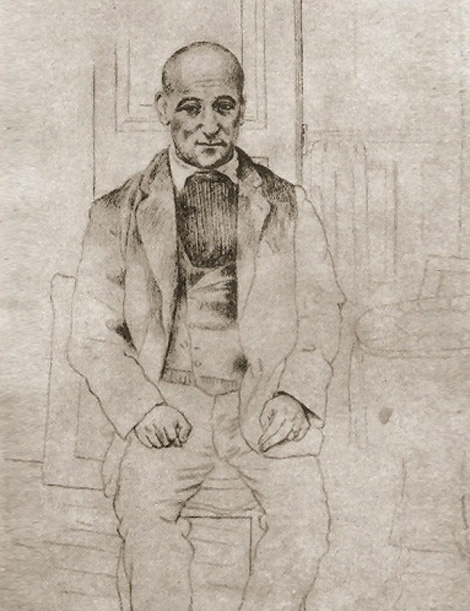
Pablo Picasso. Portrait Of Max Jacob

par Pablo Picasso                                

The beggar woman of naples

When I lived in Naples there was always a beggar woman at the gate of my palace, to whom I would toss some coins before climbing into my carriage. One day, surprised at never being thanked, I looked at the beggar woman. Now, as I looked at her, I saw that what I had taken for a beggar woman was a wooden case painted green which contained some red earth and a few half-rotten bananas …

***

Happy bananas!

Jose (Jose Angel Araguz)


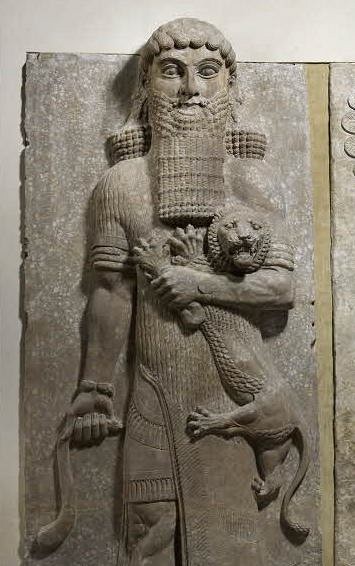
Gilgamesh (c. 2150-1400 BCE)


Hero Overpowering a Lion (by Thierry Ollivier, Copyright)

from Gilgamesh's rejection of the goddess Ishtar 

in Tablet 6:

"Which of your husbands did you love forever?

Which could satisfy your endless desires?

Let me remind you of how they suffered,
how each one came to a bitter end.
Remember what happened to that beautiful boy
Tammuz:
you loved him when you were both young,
then you changed, you sent him to the underworld
and doomed him to be wailed for, year after year.
You loved the bright-speckled roller bird,
then you changed, you attacked him and broke his wings,
and he sits in the woods crying Ow-ee! Ow-ee!

You loved the lion, matchless in strength,
then you changed, you dug seven pits for him,
and when he fell, you left him to die.

                                            --------tr. Stephen Miller 


Julio Cortazar

600full-julio-cortazar 


 ‘Letter to a Young Lady in Paris’ by Julio Cortázar, translated by Paul Blackburn (First published in English in Blow-Up and Other Stories, Pantheon 1967; also in Bestiary, Vintage Classics, 2020. 

“Andrea, I didn’t want to come live in your apartment on Suipacha. Not so much because of the bunnies, but rather that it offends me to intrude on a compact order, built even to the finest nets of air, networks that in your environment conserve the music in the lavender, the heavy fluff of the powder puff in the talcum, the play between the violin and the viola in Ravel’s quartet.”

Fernando Pessoa/Alvaro de Campos

  I Got Off the Train I got off the train And said goodbye to the man I'd met. We'd been together for eighteen hours And had a pleas...